|
|
|
|
|
 |
1.What is a vacuum? |
|
| *The word ‘vacuum’ originated from the Latin term for ‘empty’. |
|
|
1.Ideal vacuum
| |
This is also called a theoretical vacuum.
A vacuum is a volume of space that is essentially empty of matter. |
|
|
2.Vacuum in reality
| |
In reality, no volume of space can ever be perfectly empty.
Generally, a volume of space is considered to be a vacuum when its gaseous pressure is less.
than 760 mmHg (atmospheric pressure)
|
|
|
| |
|
1-1. Vacuum unit
1 unit of atmospheric pressure = 101.3 kpa = 760 mmhg = 0 torr
|
|
|
1-2.Torricelli’s experiment
1 unit of atmospheric pressure = 101.3 kpa = 760 mmhg = 0 torr??
 |
In 1643, Torricelli, an Italian physicist carried out the
following experiment with a glass container and some
mercury.
He filled a 1-meter-long and 1 cm-size glass tube
closed at one end with mercury and then inverted the
container into a basin of mercury. The column of
mercury fell to about 76 cm, leaving a vacuum above.
The space above is called ‘a Torricellian vacuum’.
The reason why the height of the mercury column is
76 cm is that the weight of the column strikes a
balance with the atmospheric pressure on the surface
of the mercury in the basin.
This experiment established the basic concept that
1 unit of atmospheric pressure is the same as the
weight of a 76 cm-high mercury column. |
The torr, a unit of pressure, was named in his honor. 760 torr, 760 mmHg, and 76 cmhg also came from his experiment.
The Korean Industrial Standard ㉿ sets Torr and Pa as the barometer for a vacuum, but Torr is more widely
used.Torr is the same unit as mmHg (for cmHg, mm is changed into cm). |
|
|
1-3. Bernoulli's theorem
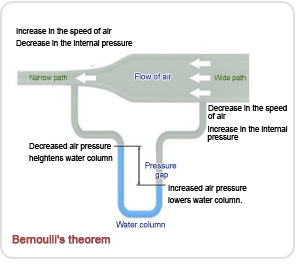 |
This is one of the basic principals of fluid dynamics and was stated by Bernoulli in 1783. It is about the relationship between speed and the pressure for an inviscid and incompressible flow. This requires that the sum of kinetic energy and potential energy remain constant.
For example, air flows through a length of pipe of
varying diameter and a narrow tube is connected to the
part with the different diameter. When looking at the
height of the water in the tube, the water column
connected to the thicker part will decrease in its height
and the height of the column linked to the narrow part
would increase. If fluid flows at the same height, the
speed of the fluid would increase when flowing along
the narrow path, while the internal pressure would
|
increase if the speed decreases. If the pressure gets high, the water column would be pressed down more
so that the height would decrease, and vice versa. |
|
|
1-4. Classification of a Vacuum
*The word ‘vacuum’ originated from the Latin term for ‘empty’.
|
| |
|
|
|
|
|
vacuum suction and
conveying
setting up a clean room
auto paper feed for printers
vacuum forming
vacuum packing
|
|
Oil rotary pump
dry pump
booster pump
blower pump
Venturi pump |
|
|
|
|
vacuum drying
vacuum distillation
vacuum heat treatment
vacuum furnace |
|
Piston rotary pump
dry pump
suction pump
oil diffusion pump |
|
|
|
vacuum coating
vacuum alloy
vacuum sealing |
|
Oil diffusion pump
cryotraps and baffles
turbomolecular pump |
|
|
|
Electronic microscope
surface research
material analysis |
|
Ion pump
Titanium sublimation
pump |
|
|
|
| |
|
| |
|