|
|
|
|
|
|
5. vacuum system circuit diagram
|
|
|
 |
| |
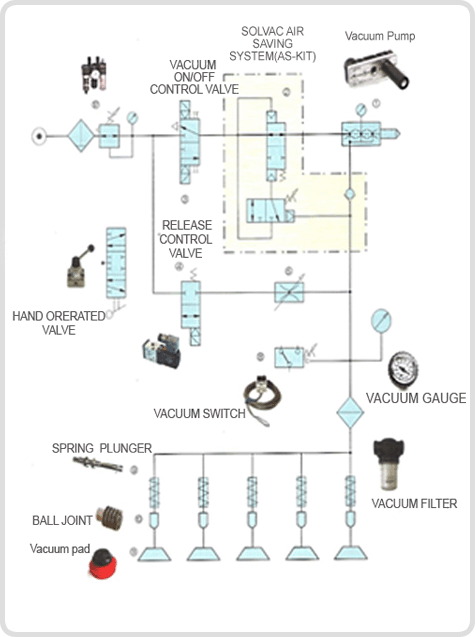
The vacuum circuit diagram list of components |
|
1. THE VACUUM EJECTOR PUMP
If compressed air (4-6BAR) is supplied to an AIR-type EJECTOR PUMP,
the VENTURI phenomenon will occur on the nozzles arranged in parallel and will
instantly generate a vacuum at the vacuum nozzle
2. THE SOLVAC AIR SAVING SYSTEM (AS-KIT)
This is a system that can dramatically save air consumption by automatically
blocking air if a vacuum reaches a certain degree.
3. THE VACUUM ON/OFF CONTROL VALVE
This is a valve that links and blocks air supply to the vacuum pump.
Various types of valves can be selected including solenoid, roller lever, and hand valves.
4. THE VACUUM RELEASE CONTROL VALVE
This is a valve that releases the generated vacuum.
5. THE NEEDLE VALVE
This is a valve that controls flow.
6. THE VACUUM FILTER
This filters out foreign matter and dust in order to prevent them from flowing into the
vacuum pump.
In order for the vacuum pump to function properly, the use of a vacuum filter is essential.
7. THE VACUUM GAUGE
This displays the degree of the vacuum..
8. THE VACUUM SWITCH
This delivers electronic or air compressing signals
when a vacuum reaches a certain degree.
9. THE SPRING PLUNGER
This controls the difference between the heights of objects to be conveyed.
10. THE BALL JOINT
If an inclined object is to be conveyed, the ball joint would work so that a vacuum
pad can be attached along the incline.
11. THE VACUUM PAD
This is attached to the surface of an object.
12. THE FILTER REGULATOR
This removes foreign matter from the compressed air supplied and maintains a
certain level of pressure..
13. THE HAND-OPERATED VALVE
This is a valve for hand operation. |
|
| |
|
| |
|